“Autopsicografia” (Fernando Pessoa, 1931)
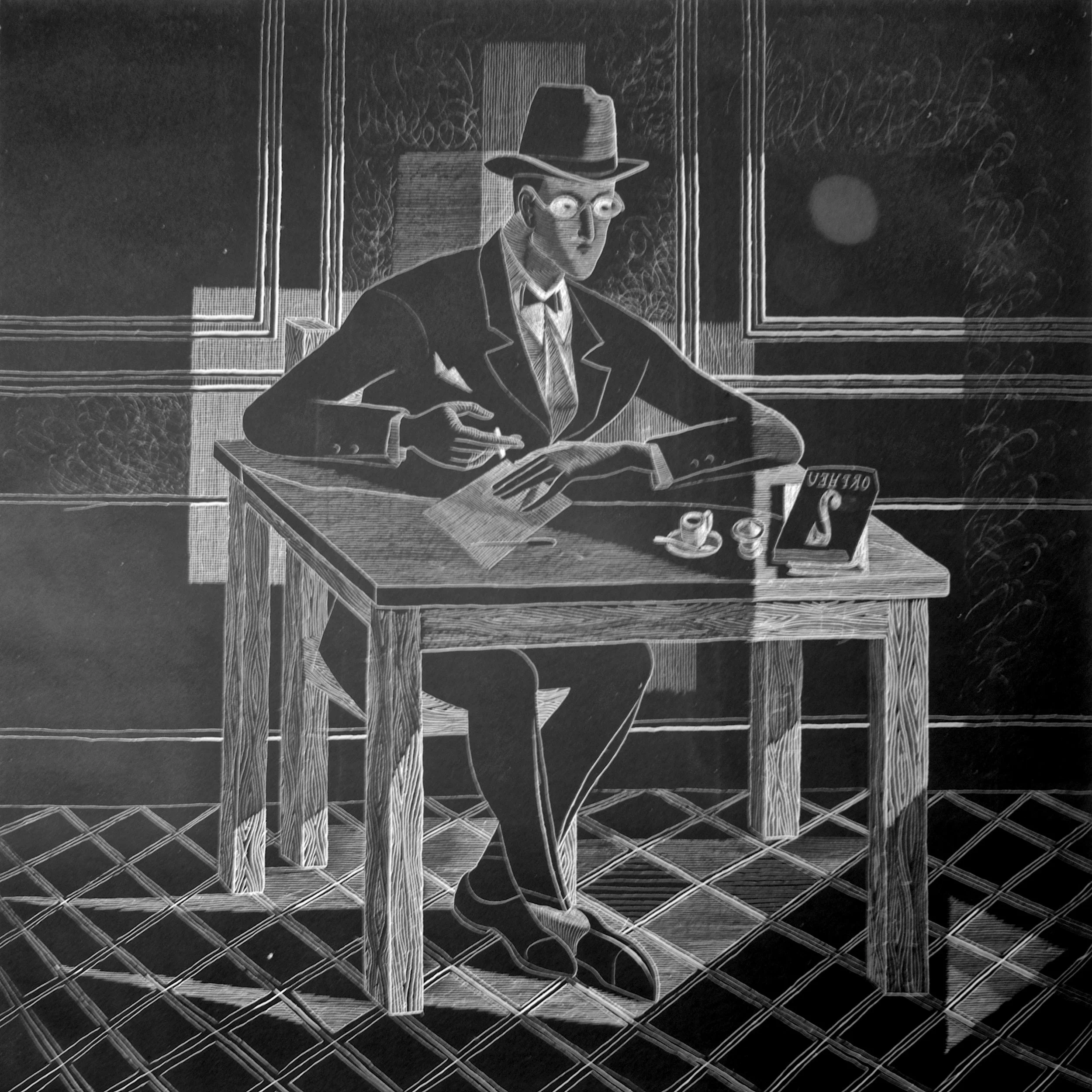
Fernando Pessoa by Almada Negreiros Source: Pedro Ribeiro Simões from Lisboa, Portugal, CC BY 2.0 <https://creativecommons.org/licenses/by/2.0>, via Wikimedia Commons
Although I mainly focus on music here on The Anvil, tomorrow marks 138 years since the birth of the iconic Portuguese poet Fernando Pessoa (June 13, 1888 – November 30, 1935), which struck me as an opportune time to take a crack at translating his seminal poem “Autopsicografia” (which wouldn’t be my first Pessoa translation). However, no surprise, it turns out that dozens of people have beaten me to the punch on translating that 95-year-old heavily anthologized piece. However, the fact that this important poem has been translated by some of the most prominent Portuguese-to-English translators does give me a chance to delve a little bit into how nuanced the art of translation can be. With thanks to Disquiet: Pessoa’s Trunk, I offer for comparison just the opening 4 lines of this 12-line poem. Here’s the original opening stanza:
O poeta é um fingidor
Finge tão completamente
Que chega a fingir que é dor
A dor que deveras sente.
This is profound and engaging, but not complicated or complex. No obscure words; no manipulation of syntax; no plays on words; just straightforward description. Right? The great Richard Zenith (1998) does a really good job in his “Autopsychography” (which is the title most translators into English use):
The poet is a faker
Who's so good at his act
He even fakes the pain
Of pain he feels in fact.
This is, in my opinion, one of the best translations of this poem (and is probably the most quoted these days). But the echo of “fingidor” in the second line (“finge”) is lost and Pessoa’s rhyme scheme is ABAB while Zenith’s is ABCB. Keith Bosley (1995) offers an ABAB translation:
The poet is a fake.
His faking seems so real
That he will fake the ache
Which he can really feel.
The repeated/echoed “fingidor”/“finge”/“fingir” in each of the first 3 lines is back, but now we have punctuation at the end of the first line. And what if “fingidor” isn’t translated as “fake(r)”? Ernesto Guerra Da Cal (1960) has another option:
The poet is a feigner.
He feigns so completely
That he even feigns that he is suffering
The pains that he is really experiencing.
Here we lose the fact that Pessoa’s last two lines say that the poet fakes the pain he is really suffering, not that he fakes the suffering. Going back to that first noun (“fingidor”) used to describe the poet. In the spirit of the relatively simple and straightforward words of the original, Marilyn Scarantino Jones (1977) offers another option:
The poet is a pretender.
He pretends so completely
That he even pretends
The pain he really feels.
Here we get back the idea that the pain that is really felt is pretended. Another big name, George Monteiro, has published two translations of this poem (1988 and 1997), both of which offer yet another option for the noun descriptor at the beginning. Monteiro is also one of very few who add the pronoun “who” to the first line enabling the verb in the second line to go without a subject, as it does in the original:
The poet is a forger who
Forges so completely that
He forges even the feeling
He feels truly as pain
Don’t care for any of the options so far? F. E. G. Quintanilha (1971) offers another possibility:
The poet is an inventor.
He invents so completely
That he succeeds in inventing
That the pain he really feels is pain.
James Parr takes an even more direct route (while pluralizing the poet):
Poets are liars.
They lie so completely
That they make up pain
Even when they're hurting.
But there’s no “liar”/“lie” in the third line and once again the pain becomes made up. Maybe, as Martin Seymour-Smith (2005) suggests, we don’t need a noun form of what poets are:
Poets pretend
They pretend so well
They even pretend
They suffer what they suffer.
Despite varying greatly from the overall structure of the original, that one does have the thrice repeated “pretend” and the paradoxical real pain that is also made up is preserved. Another translator who pluralizes the subject of the poem is Jonathan Griffin (1971):
Poets are people who feign
They feign so thoroughly,
They'll even mime as pain
The pain they suffer really.
But why “mime” instead of “feign” in the third line? Maybe we can shed the structure of the original even more, as in Roy Campbell (1960), whose version has no title but does return us to ABAB rhyme:
The poet fancying each belief
So wholly through and through
Ends by imagining the grief
He really feels is true.
The three repeated/echoed words are gone, but the pain part seems right. Another ABAB version that otherwise abandons Pessoa’s structure (and doubles up on verbs) is from Michael Hamburger (1969):
Poets feign and conceal
So completely feign and pretend
That the pain which they really feel
They'll feign for you in the end
Similarly, Peter Rickard (1971) struck out on a different path, and is one of the few to abandon Pessoa’s title, calling his translation “Self-Analysis”:
The poet's good at pretending,
Such a master of the art
He even manages to pretend
The pain he really feels is pain
This time we’ve lost the echo of “fingidor” in the 2nd line and we’ve changed from the poet being a pretender to being good at pretending. There are plenty more variations, but the above certainly demonstrates my point: Translation is hard. And nuanced. And never really done. To me, this is part of the joy of translating poetry and literature in general; the possibilities are nearly infinite and that’s something that the black-and-white “thinking” of AI will never be able to replicate. Happy Birthday to the great Fernando Pessoa and a resounding VIVA! to all the human translators out there.